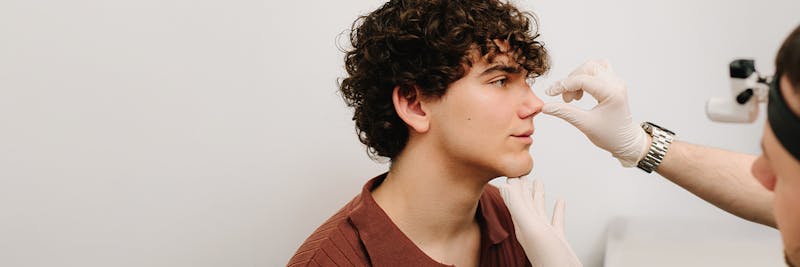
Realizing you aren't happy with the results of a previous nose job is a tough pill to swallow. Whether your nose doesn't look the way you envisioned, or you've developed new trouble breathing through your nose, feeling stuck after surgery is deeply frustrating.
Revision rhinoplasty (or secondary rhinoplasty) exists specifically to fix these issues. But because your nose has already been operated on, secondary surgery requires a very different approach than a primary procedure.
Why Revision Work Demands Advanced Expertise
If primary rhinoplasty is tricky, revision work is an art form of its own. Data from the American Academy of Facial Plastic and Reconstructive Surgery (AAFPRS) highlights secondary rhinoplasty as one of the most complex procedures in the entire discipline.
There are three main reasons why:
-
Scar Tissue: Internal healing creates firm scar tissue that changes normal anatomical planes, making delicate tissue separation harder.
-
Missing Cartilage: In many cases, too much underlying bone or cartilage was removed during the first operation. To rebuild support, surgeons often have to perform cartilage grafting—borrowing structural support from the ear, septum, or rib. The surgical teams at Johns Hopkins Medicine document how critical these grafts are for restoring both structural strength and a natural shape.
-
Compromised Airways: Cosmetic over-correction can sometimes cause the internal nasal valves to collapse, making breathing much harder than it was before your first procedure.
Common Reasons Patients Seek Revision
Every revision case is unique, but most patients who walk through our doors are dealing with one of these issues:
-
Over-resection: A "scooped out" bridge, a pinched tip, or a nose that looks unnatural or overly operated-on.
-
Under-resection: Not enough structural change was made, leaving an unwanted hump or a thick tip behind.
-
Asymmetry: Shifting cartilage during the healing phase that left the nose looking crooked.
-
Functional Problems: Internal blockages or collapsed structures that restrict airflow.
Why Timing Matters: The 12-Month Rule
It is completely natural to want a bad result fixed right away, but rushing into another surgery is a big mistake. Published research indexed by the National Institutes of Health (NIH) stresses that tissue takes at least a full year to soften, settle, and complete its healing cycle.
Operating on a nose that is still healing internally increases scar formation and lowers your chances of a great outcome. Unless you are dealing with a severe medical issue, waiting at least 12 months after your last surgery gives your surgeon the best possible foundation to work with.
Restore Confidence with South Florida Facial Plastic Surgery
You don't have to settle for results that leave you feeling self-conscious or make it difficult to breathe. Revision rhinoplasty requires extreme precision, deep anatomical knowledge, and a high level of surgical expertise—qualities that define our practice at South Florida Facial Plastic Surgery.
Whether you need complex structural rebuilding or subtle cosmetic adjustments, our team is dedicated to restoring both form and function to your nose. Request an appointment to discuss your options with our secondary rhinoplasty experts.